Why sealing outlasts every other step
A treatment reduces what is present, but it does not stop what arrives next. Sealing removes the route, and once the route is gone, the same pressure has nowhere to come in. That is why it is usually the recommendation with the longest working life.
Mice return to the spots that gave them shelter and food, and they find new spots when the old ones are closed. A sealed gap at the sill or around a pipe is a permanent change to the building, while an interior application is a temporary change to one room. Over several seasons the difference becomes obvious.
Sealing also gives you a record. A list of openings, with the repair made to each one, shows what has been done and what remains. That list is useful if the house changes hands, if a renovation is planned, or if a new sign appears in a place that was previously quiet.
What aging masonry and wood do to a seal
Brick and wood move. Foundations settle, sills shrink, and a repair that sat flush one year can leave a gap the next. Materials are chosen with that movement in mind, so the seal keeps its shape through the freeze and thaw of a Hudson Valley winter.
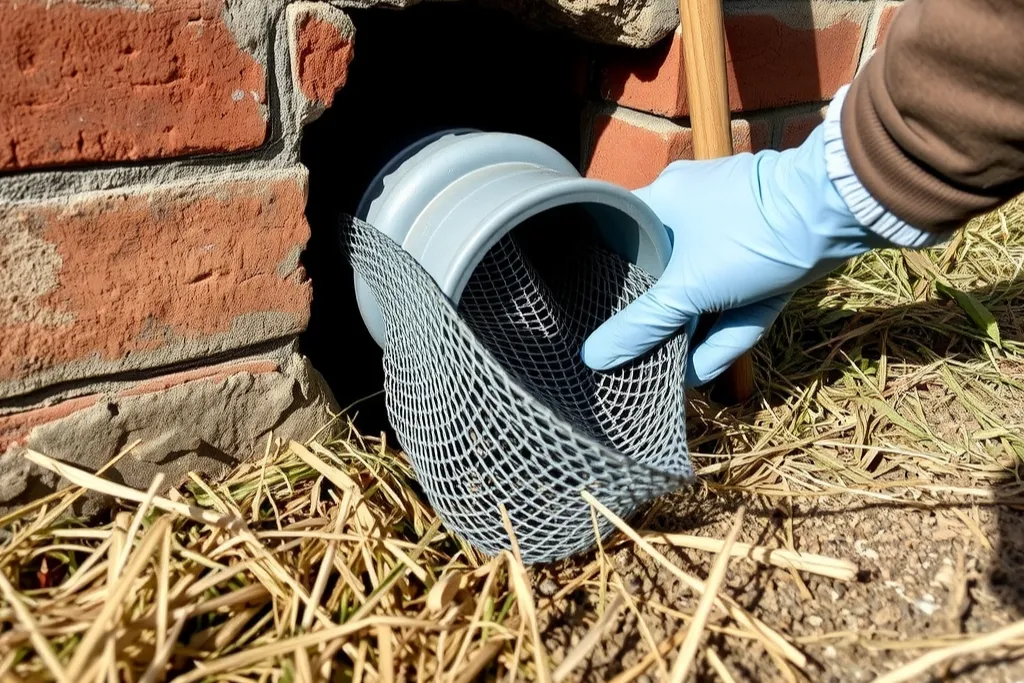
Expanding foam is useful for filling a void, but it does not stand up to gnawing alone and it can crack as the wood around it moves. Hardware cloth, a fine metal mesh, is set over larger openings before any foam goes in, so a mouse meets metal rather than a soft surface it can work through.
Caulk suits small joints where two materials meet and can flex. A door sweep at the bottom of a basement door needs to be replaced when its edge wears to nothing, and a metal collar around a pipe keeps the opening from growing as the pipe expands and contracts. Each material has a job, and the report names which one was used.
Where the openings usually are
Most openings in an older house sit in a small number of places: the sill, the utility penetrations, the basement windows and the doors at grade. Knowing those places shortens the walk and makes the list easier to check.
The sill is the line where the wooden framing rests on the foundation, and it is the most common route in an older building. Where the sill has shrunk or the mortar has failed, a gap runs the whole length of a wall, and a single repair may need to cover several feet of it.
Utility penetrations are the second place to check. A gas line, a cable, a water supply or a dryer vent passing through the wall leaves a ring of space around it, and that ring is often larger than the pipe. Each one is sealed with a material that matches what passes through it, so the repair does not become a fire or moisture hazard.
Doors, windows and the spaces people forget
Doors at grade and basement windows are frequent routes that homeowners rarely think about. A worn sweep or a broken screen can be the difference between a house that stays quiet and one that does not.
A basement window with a broken screen or a loose frame is an open invitation, particularly when a window well has collected leaves and debris against the glass. The window is repaired or fitted with a cover, and the well is cleared so the opening can be seen during later inspections.
Spaces people forget include the gap behind a dryer, the area under a kitchen sink where a supply line exits the wall, and the top of a stairwell where a bulkhead meets the house. The walk-through checks each of them because animals reach them more easily than the front door.