
Stink bugs, boxelder bugs and cluster flies look for shelter as the days shorten, not only when the temperature falls. Cornell's integrated pest management guidance names these three as the fall invaders that gather on sunlit walls and move into wall voids and attics. This guide explains what draws them in, where they hide and what sealing does and does not solve.
Key takeaways
- Brown marmorated stink bugs respond to shortening days and shelter in wall voids, not only to cold weather.
- Boxelder bugs enter through cracks and doors and also arrive on potted plants and firewood carried indoors.
- Cluster flies do not breed indoors; they lay eggs in soil in late summer and then seek attics and wall voids.
- Sealing gaps around windows, doors, vents and utility lines before the first cold nights is the most useful step.
- Vacuuming up insects that are already inside is a fair job for a household, and it removes the nuisance without spreading the problem.
- Sunny south and west walls draw the insects in the afternoon, so the openings on those sides matter most.
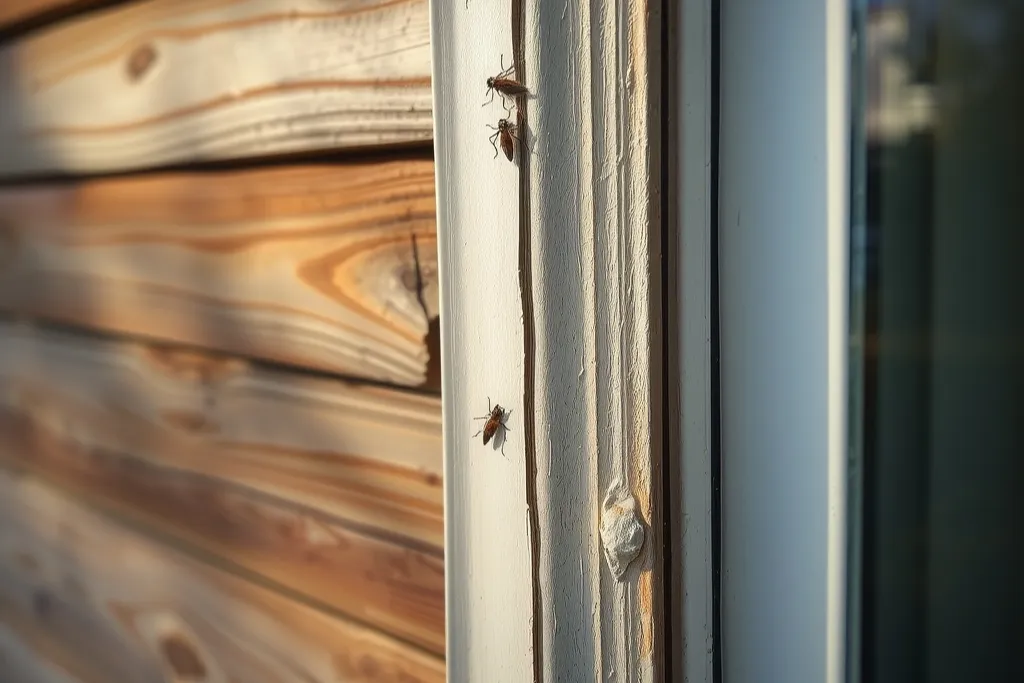
What tells these insects it is time to move indoors?
The main signal is day length. As the days shorten in late summer and fall, the insects shift from feeding outdoors to finding a sheltered place to pass the cold months, and they begin to move toward buildings.
Cornell's integrated pest management guidance describes brown marmorated stink bugs as responding to shortening days rather than to the first cold snap. The insect uses the change in day length to time its move into shelter, so the migration can begin well before the nights are really cold. A homeowner who waits for frost to act may find the insects already inside.
Boxelder bugs follow a similar pattern. They feed on the seeds of boxelder and other trees in late summer, and as the season turns they gather on sunny walls, fences and tree trunks before seeking entry. They are drawn to warm surfaces, particularly the south and west faces of a building that take the afternoon sun.
Cluster flies have a different life cycle. Their larvae develop in soil, and the adults move toward buildings in fall to find shelter, often gathering in attics and wall voids. They do not breed indoors, which is useful to know, because an indoor population is usually a group that came in from outside.
Where do stink bugs, boxelder bugs and cluster flies hide inside?
Stink bugs shelter in wall voids and behind trim, boxelder bugs enter through cracks and gather in sunny rooms, and cluster flies collect in attics, in the spaces under roof edges and in the gaps around chimneys and vents.
Stink bugs prefer hollow spaces. A wall void, the gap behind a window casing, the space behind a kitchen cabinet or the gap around a light fixture can hold a large group. They come out of these places on warm afternoons, which is why a homeowner sees them on a sunny window in the middle of winter.
Boxelder bugs get in through cracks and doors. They also come in on potted plants, stacked firewood and the bark of logs brought inside for a fire. Once indoors they gather on sunny windows and in the rooms with the most light, and they are often found in the same places year after year.
Cluster flies gather in attics, in the spaces under roof edges and in the gaps around chimneys, vents and soffits. They are slow and cluster on warm surfaces, and they can be found on the inside of a window or on a ceiling in a room that is heated above the attic. The flies are a nuisance more than a structural risk, but they are unwelcome in any living space.
What does sealing do, and where should it start?
Sealing removes the entries that the insects use, and it works best when the openings are found from the outside first, then checked from the inside for light coming through a gap.
Start with the windows and doors. A gap at the bottom of a door, a worn weatherstrip, a cracked caulk line at a window frame or a torn screen gives the insects a route. Replacing the weatherstrip and recaulking the frame before the first cold nights is a practical step that most households can take.
Look at the vents, the utility entries and the roof edges next. Vent covers with loose mesh, a pipe or cable that enters the wall through an oversized hole, a gap where the siding meets the foundation, and a soffit that has pulled away from the fascia are all common entries. Some of these need a carpenter or a roofer, and the technician will list them.
A simple check is to close the room, turn off the lights, and look for light coming through the gaps from outside. A gap that shows light is a gap the insects can use. Mark the spots with tape, then seal them with the right material for the place, such as caulk for a crack, mesh for a vent and a sweep for a door.
Why does sealing sometimes fail to stop the problem?
Because the insects may already be inside the walls, or because the entries are too many to close in one season, or because the sunlit walls keep drawing new insects toward the building.
A building that has been entered for several seasons can hold a population in its wall voids. Sealing stops new arrivals, but the insects already inside can continue to come out on warm afternoons for weeks. A technician can advise whether a treatment is needed inside the void or whether the activity will decline on its own as the season ends.
Some buildings have too many entries to close in a single visit. Older housing has openings around pipes, cables, flues and vents that were never sealed, and a full sealing plan may take several visits and some work from other trades. The plan should list the openings in order of importance, so the most useful ones are closed first.
Insects also come back to sunny walls. A building with a south or west exposure draws them every fall, and the openings on those sides need the most attention. Treating only the interior misses the source, which is the outside wall the insects gather on before they find a way in.
What can a household do about insects already inside?
Vacuum the insects up, dispose of the bag or empty the canister outside, and avoid crushing them, because a crushed stink bug releases a strong odor and can stain fabric.
Vacuuming is the most practical way to remove insects that have already come indoors. Use a hose attachment on the windows, along the baseboards and in the corners where they collect. Empty the canister or change the bag outside, and wipe the nozzle, because the insects can leave a smell on the surface.
Avoid crushing stink bugs. The insect releases an odor when it is squashed, and the smell can stay on fabric and on the floor. A jar with a lid or a cup and a card can carry an insect outside, and that method keeps the odor contained.
Remove the reasons the insects are gathering. Firewood should be stored outside and away from the wall, potted plants should be checked before they are brought in, and the sunniest windows can be fitted with screens. These steps reduce the number of insects that reach the building, which is most of the fight.
Check the attic too, since cluster flies gather there. A household can look for the flies on the attic floor and the insulation at the roof edge, and note where they cluster. Walk the attic with a flashlight and close the hatch behind you so the flies do not drift into the living space. Report the attic findings to the technician, because the attic and wall voids are the places a household can least easily reach.
When should a technician be called for fall invaders?
A technician should be called when the activity is heavy, when the insects are coming from inside the walls, or when an inspection is needed to find the entries that a household cannot reach safely.
A visit is useful when the insects are numerous, when they are found in the living spaces every afternoon and when the household cannot find the entries. The technician inspects the outside walls, the attic and the wall voids that can be reached, and writes down the openings with their positions.
The plan for fall invaders usually combines sealing with a targeted treatment where one is justified. A technician will explain which work the household can do, which needs a tradesperson and which is a pest-control task. The findings are written, so the household can follow the plan at its own pace.
Ask who attends the address and what state certification that person holds. A technician is arranged for the visit, and the technician who attends is the person whose certification applies to the work. The figure for the work is set after the inspection and approved before any product is applied.
Frequently asked questions
Why do stink bugs appear on warm afternoons in winter?
The insects sheltering in wall voids come out when the building warms in the sun. They are not breeding or feeding indoors in the usual sense, and the activity usually fades as the building cools. Cold insects are slow, so they are easier to vacuum up than to chase.
Are boxelder bugs dangerous to the house?
They are a nuisance rather than a structural pest. They do not damage the wood or the masonry, but they gather in large numbers and can stain surfaces and fabric when they are crushed.
Why do cluster flies show up in the attic?
Cluster flies gather in attics and wall voids in fall to shelter for the cold months. They do not breed indoors, so an attic population is usually one that came in from outside through a gap.
Is there a single thing that stops all of them?
No single step does. Sealing the entries, clearing the firewood and plants from the walls and vacuuming what is already inside together make the largest difference. A technician can advise where the entries are and what the plan should cover. A household that keeps a simple log of where the insects appear will see the pattern faster, and the log is useful to the technician when the plan is written.
This guide is general information for Rensselaer County homeowners, not a substitute for an on-site inspection. Prices are estimates. See our disclaimer.